A Look Back on 2025: ShareDo’s Year of Transformation and Scale

For many senior leaders in law, 2025 will be remembered as the year that demanded efficiency, accountability and clear results. After years of speculation, AI moved from promise to practice. Technology choices carried immediate competitive consequences. Fragmented, legacy systems became more than an operational drag — they became a risk.

Against this backdrop, ShareDo — now Clio Operate — focused on a clear mandate: equipping enterprise legal teams with the structural scale and stability to harness intelligence safely. As part of the Clio organisation, we accelerated that mission, supported by the acquisitions of vLex and Vincent AI. We recognise that change brings uncertainty; yet the message from clients has been consistent: legal teams are ready to modernise, provided the path is stable and the partner is proven.

This year culminated in the completion of the vLex acquisition, a Series G funding round and a $5 billion valuation for the combined Clio organisation — our strongest commitment yet to our current, and future, enterprise clients. 

In this blog, we reflect on the milestones and client decisions that shaped our year, welcome new firms into the community, and share a handful of success stories. Look out for more in 2026, including some of our largest projects and organisation‑wide work management overhauls to date.

Year in Review: Our 2025 Highlights
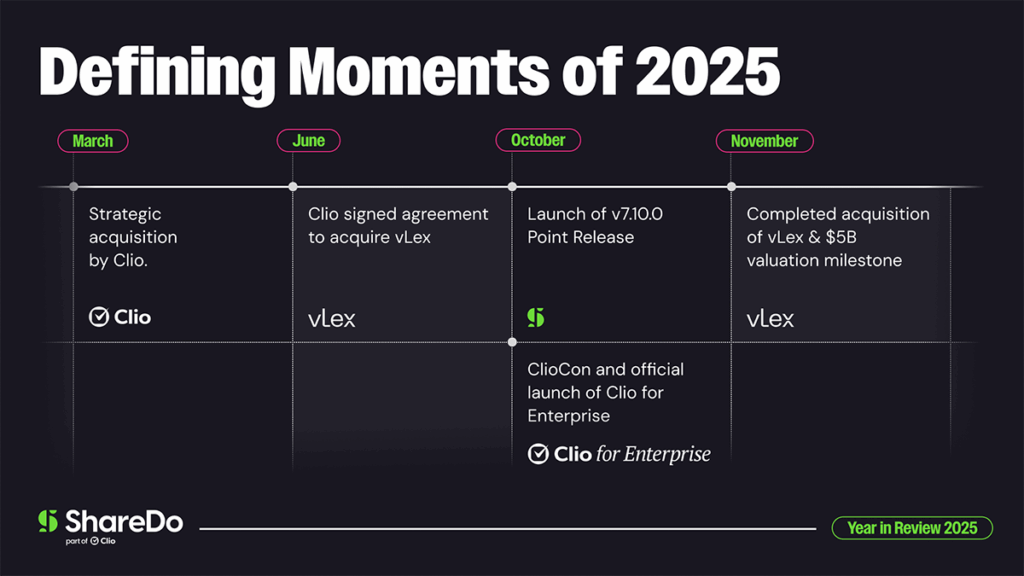
2025 Sharedo timeline

Twelve months can feel brief in a fast‑moving market, but 2025 was defined by decisive action: aligning investment, talent, and product to deliver enterprise‑grade stability and intelligence.

March 2025: ShareDo joins Clio in strategic acquisition. 

Clio completed its largest acquisition to date (at the time!), formally acquiring ShareDo and marking a decisive entry into the large law firm and corporate legal market.

June 2025: Clio signs definitive agreement to acquire vLex. 

Clio signed the definitive agreement for the US$1 billion vLex acquisition, strategically laying the foundation for our integrated legal intelligence strategy.

October 2025: ShareDo major platform release (v7.10.0). 

We delivered Point Release v7.10.0, which included 31 new or enhanced features and 51 usability improvements, demonstrating our velocity in continuous product development.

October 2025: ClioCon and official launch of Clio for Enterprise and Clio Operate

The dedicated Clio for Enterprise division was unveiled at Clio’s annual conference, ClioCon, in Boston. Alongside the launch of the Enterprise division, for the US-market, ShareDo was rebranded Clio Operate, bringing us and vLex’s Vincent AI under one, enterprise-focused roof. 

November 2025: Clio completes acquisition of vLex & $5 billion valuation milestone. 

The completion of the US$1 billion vLex acquisition and a US$500 million Series G funding round cemented the company’s $5 billion valuation, securing world-class AI assets.

Joining the Club in 2025:

This year, we had the privilege of welcoming 13 new enterprise clients into the ShareDo/Clio Operate community across EMEA and APAC. It’s a milestone we’re proud of — not just for the number, but for the calibre of firms that have chosen to partner with us. In a market defined by change, these leaders prioritised stability, scalability, and a clear product vision. We’re honoured to support their work and to be trusted with platforms that sit at the heart of their operations.

As we close out the year, our community reflects a diverse ecosystem of large law — spanning cross‑border practices, specialist leaders, and multi‑jurisdictional firms. Most recently, ShareDo/Clio Operate was the most-cited case workflow solution in Legal IT Insider’s Top 200 UK Firms Report, an achievement we’re exceptionally proud to see as we support the UK’s leading firms.

The logo wall below offers a snapshot of that breadth and momentum, underscoring the collective strength of firms aligned around a modern, intelligent approach to work management.
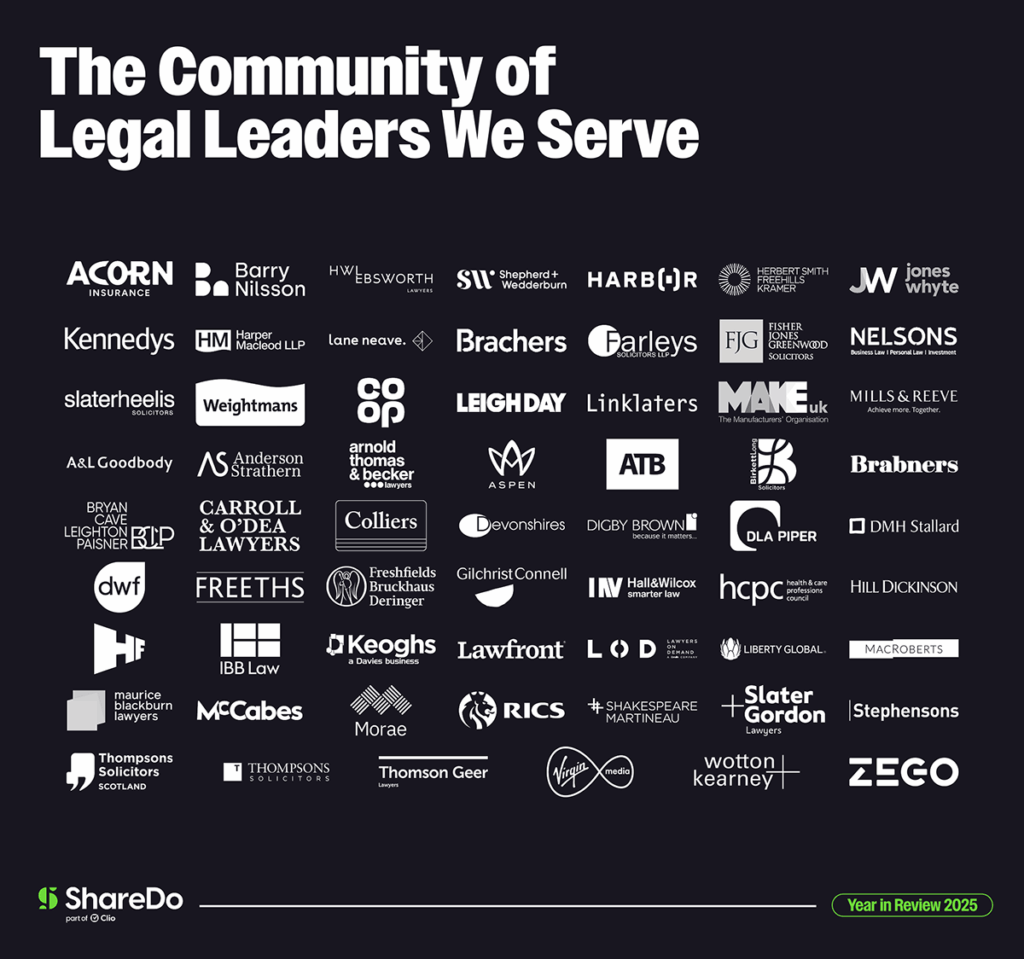
ShareDo community of Legal Leaders

Throughout every engagement, our focus has remained constant: seamless implementation, rigorous change management, and consultative support that minimises disruption and accelerates time‑to‑value. Our enterprise team partners closely with clients to ensure adoption, governance, and measurable outcomes remain front and centre.

2025 Client Partnership Highlights

Mills & Reeve (January 2025)

Mills & Reeve undertook a rigorous two‑year selection process to find a next‑generation matter management platform that could support a diverse practice and scale with the firm. Twenty stakeholders participated in a detailed evaluation — including a seven‑hour deep‑dive — before unanimously selecting ShareDo/Clio Operate. 

The decision centred on ease of configuration, accelerator packs aligned to core work types, and a truly unified platform that avoids stitching together disparate tools — alongside robust automation and clear headroom for growth. We are co‑designing a phased rollout with the firm’s Legal Technology & Data team to introduce efficiencies at a sustainable pace and protect business‑as‑usual. 

The programme is designed to deliver measurable gains in efficiency and data quality, freeing lawyers to focus on higher‑value work and client outcomes.

Leigh Day (February 2025)

Following an extensive review, Leigh Day selected ShareDo/Clio Operate to replace a legacy CMS that was slowing teams down and demanding constant manual intervention. The firm needed a platform that could integrate with existing tools, reduce administrative burden, and flex to the realities of complex, high‑stakes casework. 

ShareDo’s/ClioOperate’s modular design, open integrations and automation capabilities stood out, but so did the partnership approach — co‑creating a clear, phased adoption roadmap to minimise disruption. Implementation is underway with onboarding focused on rapid user confidence and pragmatic change management. 

The result is a modern operating environment that improves collaboration and data accessibility today, while positioning the firm to make faster, more informed decisions across its portfolio.

Slater and Gordon (June 2025)

With multiple on‑premises CMSs inherited through acquisitions, Slater and Gordon faced the familiar risks of inconsistent processes, heavy support overheads, and slow change. After a year‑long RFP, ShareDo/Clio Operate met 95% of the firm’s 198‑point evaluation — selected for its cloud‑first architecture, Microsoft‑centric integrations and low/no‑code extensibility, all aligned to a wider strategy to move 95% of operations to the cloud by 2026. 

A late‑breaking deadline accelerated phase one: migrating 80 users and over one million documents in just 12 weeks. Using solution accelerator packs, rapid build cycles and an intensive training programme — often delivered within 24 hours of new capabilities — we went live on time, with higher stability and performance from day one. The firm is now progressing complex practice migrations, deeper integrations and targeted automation to compound those early gains.

This is  just a couple of this year’s success stories — look out for more in 2026 as we share some of our largest projects and organisation‑wide work management overhauls to date.

Product Updates and Feature Releases: 2025 Highlights

2025 was not simply a year of M&A; it was a year of accelerated investment in the product you rely on every day — from document management to workflow analytics and reporting. The result is a more resilient, intelligent platform designed to reduce complexity and cognitive load for busy legal teams.
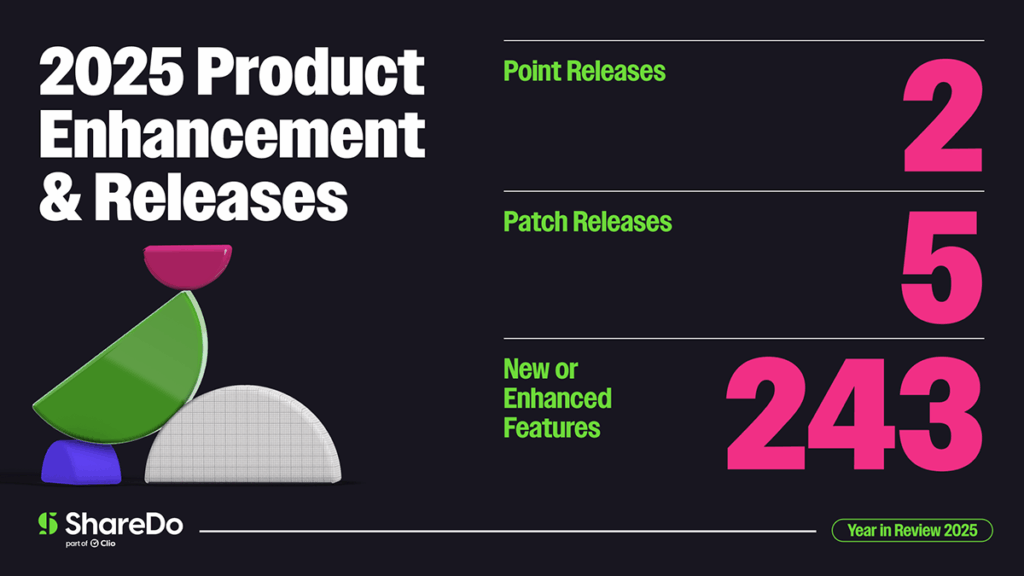
Product enhancement stats

Major Release: Version 7.10.0 (October 9, 2025)

Our point release v7.10.0 was a significant moment for our development programme. This release alone included 31 new or enhanced features and 51 resolved issues, demonstrating our ability to balance strategic integration with relentless attention to usability and security.

Enhanced reporting and data visualisation

Strategic oversight: New Report Designer and Dashboard Design canvases let modellers build custom reports and cohesive visualisations from List View data—giving leadership more granular, real‑time control.

Future‑proofed analytics: Legacy ‘Radar’ and Key Facts widgets deprecated in favour of modern, List View‑based analytics that enable actionable insights.

Workflow analytics and management

Smarter process control: Workflow Analytics surfaces instances, error rates, and durations — accelerating troubleshooting and optimisation for CIOs and COOs seeking performance assurance.

Stronger data governance: New Workflow Actions for Organisations, People, and Locations in the Operational Data Store improve master data management and downstream data quality.

Documents and user experience

Compliance and brand control: Configurable global and individual email signatures — set firm‑wide or allow governed overrides.

Document efficiency: iManage search integration and resizable document previews streamline repository management and review.

ShareDo/Clio Operate Around the World

In 2025, we accelerated our growth beyond the UK — showing up where it mattered, from a milestone ClioCon in Boston to client rooms in Sydney — so firms can adopt secure, scalable innovation with confidence.

The energy was unmistakable at ClioCon. On 16 October, Jack Newton, Clio’s CEO, introduced Clio for Enterprise and positioned ShareDo (now known as Clio Operate) as its adaptive work management backbone. 

With more than 2,000 legal professionals in attendance, we were delighted to meet so many from the Clio community — across packed demos, roadmap sessions, and customer roundtables. Demonstrating Vincent by Clio and Clio Operate working seamlessly within daily workflows, we showed how unified legal intelligence reduces context switching and increases matter velocity — practical gains for teams under pressure to deliver more with less. The mood was clear-eyed and optimistic: at enterprise scale, stability and governance are now prerequisites for safe, effective AI adoption.

We also deepened our presence in Australia and New Zealand. In February, our Chief Customer Officer, Jennie Strickland,  and colleagues were in Sydney for hands-on work with clients and partners, including a two-day Solution Architecture training and an informal community meet-up. These sessions were as much about listening as enablement — understanding local priorities, change-management realities, and operational constraints. 

Jennie's post

We returned to Australia in October for Clio’s Innovate Legal Summit 2025, strengthening relationships and our regional ecosystem. Our promise remains simple and consistent: we will meet you where you are, with practical guidance and a platform you can trust.
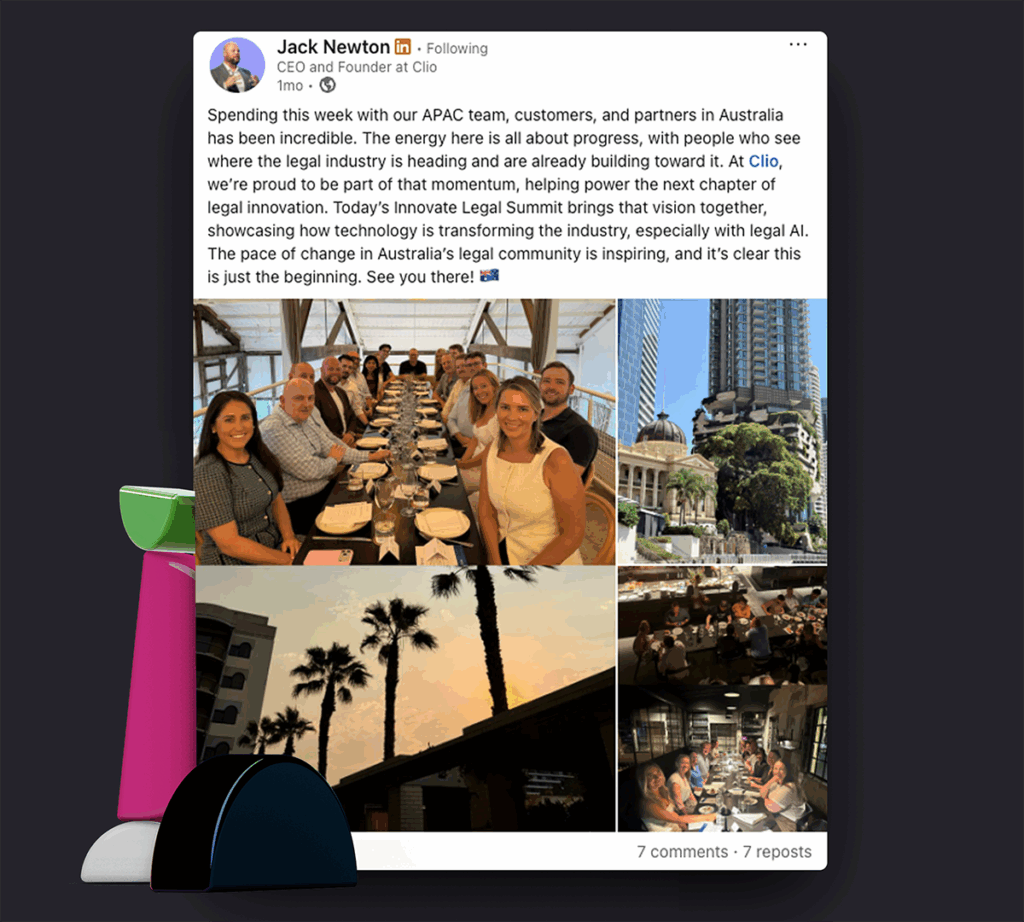
Jack's post

Scaling Our Global Team and Expertise

In 2025, the Sharedo/Clio Operate division added 36 new team members across all departments, including Engineering, Customer Success, Sales, and Marketing. And we’ve expanded our people locations too – with new teammates joining us from across the UK, North America, and APAC. 
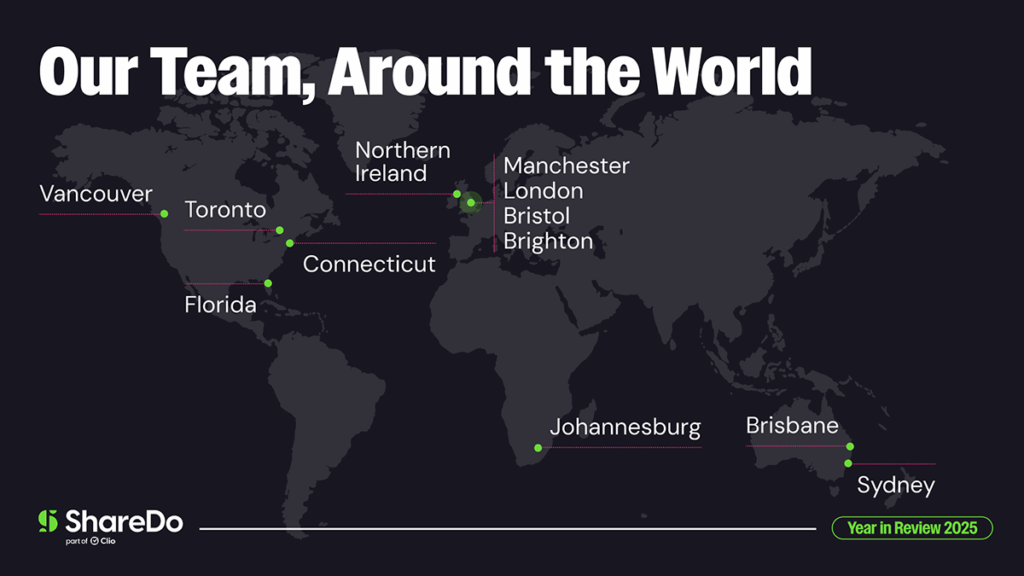
A map of the world showing the locations of our team

This growth strengthens the disciplines that matter most to enterprise delivery: solution architecture, customer education and success, systems engineering and QA, and market-facing roles that translate complex capability into measurable client outcomes.

This expansion, exemplified by the integration of 350+ experts through the vLex acquisition into the wider Clio organisation, ensures ShareDo/Clio Operate clients benefit from deep expertise across Product, Engineering, and Customer Success — driving continuous innovation and dedicated, enterprise-grade support. 

What’s Ahead? The Future of Law with Clio for Enterprise

2025 was a year of strategic consolidation; 2026 is the year we scale those benefits across our global client base. We end the year with a clear sense of purpose and a firm commitment to transforming how law is practised and managed — safely, pragmatically, and at enterprise scale.

Our focus is disciplined innovation. We’re building on 2025’s foundation to deliver new, secure capabilities and cutting‑edge features in Clio Operate — prioritising privacy, governance, and day‑to‑day reliability. Expect responsible AI by design (human‑in‑the‑loop, auditability, and role‑based controls) that makes advanced technology accessible to busy enterprise teams without compromising risk management.

We will also deepen the connection between business operations and legal work. Matter management and workflow orchestration in ShareDo/Clio Operate will integrate seamlessly with the practice of law — powered by research and AI through Vincent by Clio — and complemented by specialist tools like Clio Docket and Clio Library. The outcome is a system that shortens cycle times, improves matter economics, and elevates client value.

As we head into the new year, we’re inspired by the ClioCon 2026 theme, “Go Beyond Limits,” and will help firms challenge constraints with practical tools, robust change‑management support, and measurable outcomes. Our implementation programmes, change management workshops, and customer education will ensure your teams not only adopt new capabilities but realise lasting performance gains.

Thank you for the trust you’ve placed in us throughout this momentous year. 

Here’s to another exciting year ahead! 

The Great Redesign: Legal Geek Confirmed the Future of Law is Hinged on Wisdom and Control

Every year, Legal Geek serves as less of a trade event and more of a pivotal strategic reset for the law’s most forward-thinking leaders. And this year was no exception.

The ShareDo team loved connecting with so many of you at our booth and we were thrilled to see our very own Carlos Carvalho fill the seats at the Disco stage, where he challenged global firms to stop selling just “efficiency” and start selling exceptional client experience. Now that the coffee has worn off and the Old Truman Brewery air has cleared, we’ve had a chance to digest all the conversations we had over the two-day event.

The clearest takeaway was how exciting this period of change actually is. The constant noise and speculation around AI is finally giving way to clear, strategic direction for the future. This transformation in large law defines a necessary shift in value: moving away from mere production capacity (which AI is rapidly automating) toward human wisdom, emotional intelligence, and control over complex operations.

This shift moves the conversation past the fear of automation. We are no longer worrying about “AI replacing lawyers;” instead, we are focused on elevating the lawyer’s role to its highest professional potential.

Legal Geek Key Trends and Takeaways:

Across multiple stages, featuring over 250 speakers and countless round-tables, the focus was on the single goal of future-proofing legal services, and the key themes resonated universally. These are not isolated ideas; they are interconnected strategic drivers.

What does that shift look like in practice? The consensus points to five fronts driving the need for a legal redesign:

1. AI as the Catalyst Driving Pricing Model Changes

Anyone who has spent time in legal operations knows the debate around the billable hour isn’t new — for years we’ve talked about its flaws and the challenges it can cause with client expectations. However, this year at Legal Geek, the conversation on profitability was hopeful, as Generative AI has provided the necessary catalyst to drive a new economic model forward.

The core conflict lies in the traditional fee structure, which features two distinct approaches with inherent flaws.

In fixed fee work, profit is maximised by efficiency — the faster the lawyer completes the case, the higher the margin. This can often incentivise the use of the lowest-cost staff to maximise profit, which can risk compromising service quality. In hourly rate work, the system pits the firm against the client. The final cost is uncertain, making legal work challenging for consumers to access and the system creates a disincentive for lawyers to be efficient, as fewer billed hours mean less revenue.

AI is now fundamentally disrupting the core mechanism of profit generation in both approaches.

Paul Lewis, Managing Partner at Linklaters, was clear: “The structure for monetising production will have to change,” forcing firms to provide a service fundamentally different from what a machine can deliver. This is why Jo Farmer, Joint Managing Partner at Lewis Silkin, noted that firms engaged in high-volume transactional work face a shift to aligning staff roles and pricing with future market value.

Since AI makes completing work exponentially faster, and in many cases replaces the need for a bottom-heavy, junior workforce, this mandates moving to project-based or hybrid pricing, as firms can no longer charge a premium for easily automated work. This new efficiency also means junior lawyers are stepping into more advanced, high-value work earlier in their careers, further demanding a change in how time is priced.

With the client now controlling the value equation and expecting real cost savings where automation is used, firms need to be prepared to offer better transparency into their fees. Lewis added that firms need to be proactive and upfront with their breakdowns and cost of work, even going as far as offering transparent fees for work done “with and without AI.” This client expectation for value puts immediate pressure on firms to adopt the technology that they might previously have shied away from and requires a shift toward flexible, value-based pricing models that clients can easily justify.

2: The New ROI: Happiness, Adoption, and the “Riot Test”

For years, firms measured the return on tech investment purely through traditional quantitative metrics: the time shaved off a case, or the percentage reduction in outside counsel spend. This year, the industry declared those metrics incomplete. The most exciting shift at Legal Geek was the recognition that an equally vital strategic goal is achieving happier lawyers.

This transformation puts user satisfaction centre stage. Emily Lew, Client Strategy Consultant at Draftwise, perfectly articulated the new gold standard for adoption: the goal is for users to “riot if they don’t get access to the tool.” That is the litmus test we should be working towards.

It confirms a fundamental change in priorities — for the first time, we are looking at how successful technology makes our legal workforce feel, not just how much work they push out.

This focus requires us to evaluate the qualitative ROI of the tools we use every day. Elliot White, Head of Innovation & Legal Tech at Addleshaw Goddard, put it plainly: successful technology should make the lawyer’s life better, easier, and less frustrating. Efftichia Dower, Legal Transformation Simmons & Simmons Middle East, confirmed this from the in-house perspective, stating the ultimate measure of any platform’s success is the “happiness of the team.”

To make this happen, we need to be thoughtful, not reactive. To avoid tool fatigue and poor investment decisions, Dower stressed a crucial warning: “Automating a broken workflow only makes you faster at doing the wrong thing.” Firms must adopt a process-first mindset, mapping out and streamlining existing processes before touching the technology.

Measuring this success requires a clever, proactive approach. Firms need to run early user surveys to establish baseline metrics, tracking things like job satisfaction or hours spent on specific tasks before implementation. This ensures they can prove the platform’s long-term value years down the line, especially once the initial time-saving benefits become the invisible “new standard” everyone just expects.

The ShareDo Solution: A Focus on Empowerment

This focus on empowering the user — on supporting the lawyer’s actual workflow — is why firms and platforms are collaborating for true, long term success.

Take ShareDo’s recent partnership with Horwich Farrelly. They weren’t just looking for speed; they needed to eliminate the daily friction and “workarounds” that were frustrating their legal experts handling a high volume of complex motor claims. They chose a solution designed around the user, resulting in immediate high adoption.

John Presland, Chief Information Officer at Horwich Farrelly, beautifully summarised the emotional and business payoff: “Implementing ShareDo has been the cherry on the cake for us. It has removed the frustrations and workarounds of our old system, allowing our legal experts to focus on delivering exceptional client experiences… It’s not just about technology or data — it’s about enabling our business.”

By providing intuitive, friction-free workflows, platforms like ShareDo help staff feel truly empowered and equipped for the high-value work this new era demands.

Beyond the internal team, the “tech riot test” extends directly to your clients — both current and prospective. For major B2B legal work, corporations evaluate the seamlessness of a firm’s technology as a key factor in choosing a new legal partner. A modern, intuitive system reduces friction not just for the lawyers, but critically, for the client’s own legal operations team managing the relationship. This means that with an adaptive work management system in place, you can drive revenue and acquire new business by significantly improving the firm’s technological appeal in competitive tenders.

If you’re ready to adopt technology your lawyers will genuinely champion — and will pass the riot test with flying colours — book a demo with the ShareDo team today.

3. The New Talent Model: Bottom-Up Wisdom

The most exciting long-term shift Legal Geek confirmed is how AI completely rewrites the career path for young talent. If technology will gradually take over production capacity, the core purpose of a junior lawyer will shift, requiring firm leadership to fundamentally reinvent how talent is nurtured and what skills are valued.

Many will argue this shift is already well underway. Trailblazing firms are not waiting, with early adopters having already invested heavily in legal tech implementation and training, allowing them to begin aligning their junior staff roles with the future state of legal service delivery.

But this change is also being driven from the bottom up. AI-literate graduates can now “jump in at a much higher level” than ever before, as Jo Farmer of Lewis Silkin noted. This shift — “The Junior Leap” — frees them from the traditional apprenticeship model of repetitive tasks and moves their focus immediately from “doing” to “thinking.”

Since AI can support tasks like technical knowledge and first drafts, the essential skill for future firm leaders is wisdom and emotional intelligence (EQ). Paul Lewis of Linklaters made a powerful point on this, stating that the most successful lawyers have always excelled at strategic empathy and navigating client nuance, consistently demonstrating high EQ. Now, that human element is the primary differentiator and a mandatory recruitment focus.

However, developing this next generation requires commitment. Leadership must adapt to this “Upside-Down Leadership” model. Charlie Leveque, Co-Managing Partner at Harbottle & Lewis, discussed the critical need to create “psychological safety” and actively incentivise engagement with AI-powered technology. Leaders must reward juniors vocally for taking risks and experimenting, fostering a culture of curiosity over risk aversion. For firms to truly develop this high-value EQ and client-service expertise, they must commit to creating space for wisdom, dedicating non-billable time and resources (such as six-month internal secondments) to move away from a rigid billable-hour mindset.

This creates a genuinely exciting opportunity for young legal professionals. They are often the first to adopt and experiment with new tools, and now, technology is affording them the time to develop high-value EQ skills much earlier in their careers. The current generation of junior staff are no longer squirrelled away manually building transaction bibles or drowning in tedious document review; they are driving change, and firms must support their bravery and curiosity.

4: Tech Execution Demands a Technical Co-Pilot Not Just a Software Vendor

Legal Geek confirmed what many internal tech champions already know: the biggest blocker to transformation isn’t bad technology, it’s internal organisational friction. This friction is the primary cause of project failure and the notoriously long sales cycle, demanding a powerful new capability from legal operations.

Firms constantly run the governance gauntlet. While there’s an acceptance that implementation takes a long time (12 to 18 months seems the consensus), it’s not because of coding. The delay comes from internal governance layers — IT, Procurement, and Finance — and a persistent lack of executive consensus.

While some red tape will always exist, an evolving shift is allowing Legal Ops to become the technical co-pilot. This requires developing a deep technical aptitude to manage the “necessary tension” between IT’s need for standardisation and the business’s demand for speed. Christopher de Waas, Manager of Digital Transformation at Rio Tinto, proved this expertise is essential, demonstrating how Legal Ops can negotiate complex integrations and drive change without being reliant on expensive external consultants.

This shift in internal capability changes the expectation for external vendors. A vendor can no longer just sell software; they must act as a sophisticated partner. Emily Lew of Draftwise noted that the vendor must understand the client’s internal politics on a deep level and be prepared to do the “heavy lifting” to help cut through the red tape. This includes proactively helping clients secure executive sponsorship and providing a clear, step-by-step roadmap for adoption.

Finally, firms need to accept that innovation involves risk, but that risk must be contained and learned from. Elliot White, Director of Innovation & Legal Technology at Addleshaw Goddard encapsulated this need for psychological safety, noting that it’s “fine to fail, but fail as a team.” A non-adopted pilot is not a failure; it’s a learning experience. Firms must dedicate an innovation budget specifically for safe experimentation, fostering a “fail fast culture” that encourages progress.

The ShareDo Partnership: Crushing the 18-Month Barrier

This is where working with a deeply knowledgeable partner, like ShareDo, is essential to beating the notorious 18-month barrier. When Slater and Gordon decided to migrate 95% of its business to the cloud, the expected timeline was 18 months. An unexpected issue forced the firm to accelerate the first phase, migrating 80 users, thousands of cases, and a million documents to the new CMS in just 12 weeks.

Slater and Gordon didn’t just buy a system; they partnered with a team committed to building a system that worked for them. CTO Simon Martin was clear: “ShareDo’s team was brilliant in terms of rapid development and support — very thorough, personable and authentic. We wouldn’t have been able to deliver this phase without it.”

By partnering closely with their Legal Ops team, and using ShareDo’s solution accelerator packs (pre-defined, configurable workflows that help fast-track implementation), the team moved at the speed of necessity as a partner, not at the speed of bureaucracy as a vendor.

You can read more about our partnership with Slater Gordon here, or reach out to the ShareDo team to learn more about our Solution Accelerators.

5. AI Trust is Built on Clean Data and Strict Human Oversight

Amidst the energy around adoption and efficiency, a persistent, serious theme emerged: the speed of AI cannot be allowed to outpace the imperative for safety. The discussions on risk centered on two non-negotiable foundations for deploying AI responsibly: clean data and clear accountability.

The first foundation is simple: everything relies on data integrity. Successful AI deployment is impossible without clean data. Case studies showed that AI is only reliable when firms commit to the hard work of turning vast amounts of unstructured contracts and files into “repeatable, normalised, and structured signals.” Without this foundational step, AI will be inherently unreliable and expose the firm to unacceptable — and often, irrevocable — risk.

The second foundation is accountability, and the regulator was clear on this point. Aisling O’Connell, Regulatory Policy Manager at the Solicitors Regulation Authority (SRA), confirmed that the same professional duties apply to the use of AI. This mandate requires strict human oversight and transparency with clients. The lawyer remains fully accountable for all advice and work product, which immediately confirms that secure, private platforms are essential.

Finally, firms must look at their technology stack through a lens of long-term security. Innovation leaders stressed that platform agnosticism is security. Firms require an operational platform, like ShareDo, that is vendor-agnostic, allowing them to switch between external large language models (LLMs) providers (for example, switching from one major provider to a niche, specialised model) without rebuilding their entire operational system. This strategy protects the firm’s long-term investment and ensures business continuity and regulatory compliance regardless of which AI model currently leads the market.

From Hype to Strategy: The Final Takeaway

Legal Geek 2025 wasn’t just about looking at technology; it was a collective agreement to move forward with a shared, actionable roadmap. We are perhaps approaching the end of the AI-hype cycle and starting a new era of strategic execution.

The path forward for any ambitious firm, from tackling the billable hour to passing the “riot test”, is clear: success hinges on embracing this redesign. You need an operational platform that can govern data, integrate best-in-class AI tools, and free your most valuable assets — your people. The goal, as Carlos Carvalho championed, is to move beyond selling mere efficiency and focus on human wisdom, client experience, and sustainable profitability.

This transformation is the profession’s greatest opportunity to grow. By focusing on human wisdom and operational control, we can build a profitable, sustainable legal practice where the lawyer’s role is elevated to its highest, most valuable potential.

If you missed us at Legal Geek, you can still catch up with our team. Book a demo with a ShareDo expert today to start building your future-proof practice.